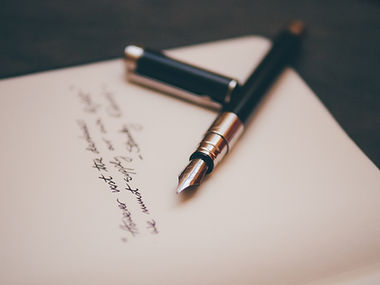
There’s a book sitting on my bookshelf. The cover is long gone. The binding barely holds the pages together. But I could never bring myself to throw it away. A book I’ve had with me since my childhood. A book filled with different happily ever after stories that my mom would read to me every night until I fell asleep. A book that quietly planted something in me I wouldn’t fully understand until years later—a need to tell stories, to find myself in words, to write.
Ever since my mom introduced me to the world of books and imagination, I’ve never been the same. The distinct smell of paper and ink the moment you crack open a new book. Getting lost in the words as though you’re living inside the story. The joy of escaping reality and diving into a whole new world where anything is possible. Once that feeling finds you, it never really lets go.
But reading was never enough for me. There was always this itch—this feeling that I didn’t just want to live inside someone else’s story. I wanted to create my own. I wanted to be the one building the world, choosing the characters, deciding what happened next. I didn’t know what to call that feeling at seven years old. I just knew I had to pick up a pencil and see what came out.
By the time I was in 3rd grade, I had written my first original story—a vampire story that came entirely from my own imagination. No prompt, no assignment, no teacher asking me to. Just me, a pencil, and a story that had been living in my head until I finally let it out. I remember bringing those handwritten pages to my mom, this little girl so proud of something she made from nothing, and watching her read every single word. She laughed and said she wanted to post it on Facebook, but didn’t want anyone stealing my ideas. But I didn’t care about any of that. I just wanted her to read it. That moment—handing someone something that came entirely from your own mind and watching them receive it—stayed with me in a way I couldn’t explain then but completely understand now.
Looking back now, I can see that instinct was already there—to take something familiar and find a different angle, to push the story somewhere unexpected, to make it mine. I just didn’t know yet that instinct had a name. Or that one day I would finally trust it enough to follow it.
High school is where everything started to click for me.
I had always excelled in English classes, but high school pushed me further than I expected. My sophomore year brought something I didn’t see coming—a teacher who would become one of the most valuable presences in my academic life. I had just transferred to a new school, and I was very quiet. Very closed off. Not the usual version of myself that had opinions and thoughts spilling out of her, even when no one asked. I kept my head down and tried so hard to just disappear into the background.
Then one day, we were discussing Lord of the Flies—specifically a scene where one of the boys finally commands the room’s attention in a moment that silences everyone. My teacher asked for thoughts, and I remember the room going quiet. But my mind was going a hundred miles a second. I had so much to say. I always did. But I was afraid. She looked at me the way only a good teacher can—like she already knew something was in there and she was just waiting for me to let it out. So I raised my hand. I gave my interpretation of the scene. And I remember the look on her face shifting—this quiet recognition, like yes, that’s it, that’s exactly it. She gave me a shout-out in front of the whole class, and I remember just feeling proud of myself. For someone who had been invisible all year, that moment cracked something open in me. I started speaking up more. I started trusting my own thoughts.
That same year, I took a creative writing class—a class that gave me something I hadn’t felt since those early childhood stories—complete freedom. Write whatever you want. No boundaries, no limitations. So I wrote something that mattered to me. Something I felt strongly about. Something real.
My creative writing teacher read every story before printing them for an anonymous class reading—so when we got to mine, and he praised it out loud, it felt amazing. He said the message was powerful, the creative range unlike anything he had seen from a student. Coming from a teacher known for being tough—someone who only gave perfect scores when a student wrote something truly original—those words meant everything. It was the kind of recognition that stayed with you.
That same recognition showed up again when it came time to apply for college. I knew my personal essay was going to be vulnerable—really vulnerable. I wrote about being a girl from an immigrant family, growing up in a lower-income city, having teachers tell me I would never amount to anything. I wrote about the dark moments, the doubt, the odds stacked against me—and how I overcame all of it anyway. It was the most honest thing I had ever written up to that point.
And the only person I trusted to read it was my sophomore/senior English teacher.
I gave her my draft one morning, and the next day she pulled me aside before class. She hugged me and told me how moved she was reading where I came from and how proud she was of how far I had come.
That moment has stayed with me. Not because of the praise but because of what it showed me—that my writing could make someone feel something real. That it could reach people in a way I hadn’t fully understood yet. It confirmed what I had known since I was a little girl writing stories at my kitchen table—I was meant to do this.
So with that thought in mind, you would think I’d choose to pursue a degree in English or literature or literally anything in that field, right? Well, I hate to break it to you, but I did not. Even though I always knew I wanted to write, I just didn’t believe it was possible. Growing up in an immigrant household teaches you certain things early—stability matters, practicality matters, dreaming is a luxury you earn after the bills are paid. So when it came time to choose a path, I chose the one that made sense on paper. I chose accounting. And I told myself the writing could wait.
What I didn’t expect was how much it would cost me. Not just the long hours or the pressure—but the slow disappearance of the things that made me feel like myself. I stopped reading. I stopped writing. And somewhere in between the deadlines and the exhaustion, I stopped recognizing who I was outside of the job. I didn’t lose myself all at once. It happened quietly, piece by piece, until one day I looked up and realized the light was almost completely gone.
So I left. And what I thought would feel like relief at first just felt like emptiness. I had spent so long inside a version of myself that didn’t fit, that when I finally stepped out of it, I didn’t know who was standing there. I felt lost in a way I hadn’t expected—like a person with no direction and no map. My mom kept asking me what I wanted to do next. And for the first time in a long time, I said the thing I had always known but never let myself say out loud. I want to write. I want to be in the world of books, words, and storytelling. I want to feel like myself again.
What pulled me out wasn’t one single moment, though. It started with a question I kept asking myself—if I actually wanted to get into the writing world, what would I even need to do? So I started researching. And everywhere I looked, every application, every opportunity, the same word kept showing up: portfolio. So I built one.
And then something clicked. I started thinking about the topics I wanted to write about—things that felt personal and real, but also universal. Things I knew other people were thinking and feeling, but maybe hadn’t found the words for yet. And once I had those topics in my head, I couldn’t stop. Every time I sat down to write, it just poured out of me—this cathartic release of getting everything I had been carrying and thinking and feeling out of my head and onto a page.
For the first time in a long time, I felt like myself again. Not the version of me that showed up to an office every day and performed competently, but the real one. The one who has been writing since she was seven years old and never really stopped believing she had something to say.
Writing didn’t just come back to me. It reminded me of who I had always been.
I remember sitting with my mom not too long ago, still feeling the weight of everything I had walked away from, still unsure of what came next. And she looked at me the way only a mother can and said something I needed to hear more than I realized—that I was still young. That I still had time. That taking a chance on something you’ve always loved is never as scary as spending a lifetime wondering what would have happened if you had.
And she was absolutely right.
I’ve spent enough time being practical. Enough time choosing the safe path over the real one. Enough time telling myself the writing could wait. I spent years believing that writing was something I had to earn the right to pursue. That it wasn’t practical enough, stable enough, realistic enough. So I told myself it could wait. And it did wait—patiently, quietly, never really leaving—until I was ready to come back to it.
I think a lot of people in my generation carry something like this. A dream they shelved because the world made practicality feel like survival. A passion they talked themselves out of because the risk felt too big and the reward felt too uncertain. We were handed a world that made just getting by feel like an achievement—and somewhere in the process of surviving it, we forgot to ask ourselves what we actually wanted.
I’m asking now. And the answer is the same one it has always been—since I was seven years old writing vampire stories at my kitchen table, since a teacher pulled me into the hallway and told me she believed in me, since I sat at my laptop at 4 am and couldn’t stop writing even if I tried.
It was always this. It was always writing.
And I’m done waiting for permission to choose it.
© 2026 Makaia's Writing Corner. All rights reserved | Privacy Policy | Accessibility Statement